
Although taking a broadly “conservative investment” position, the wealth management firm is also unafraid, it says, to state that the US remains “uniquely positioned” in macroeconomic terms.
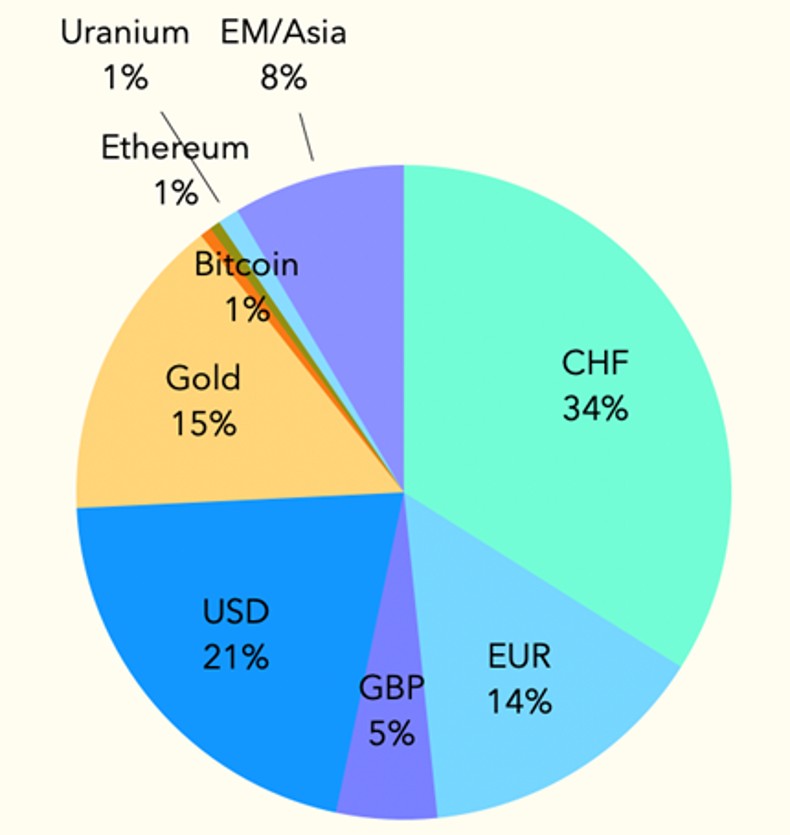
Welrex, a digital wealth management platform, will have reasons to feel cheerful after stating in its 2026 outlook that about half its portfolio is allocated to Swiss-hedged assets and gold. And it has turned more upbeat about the US market than was the case in 2025.
The firm (see more about it here and here) said it is keeping to a “conservative investment” position this year – holding a broadly equal weighting between stocks and bonds and implemented by a thematic strategy across different assets. It also has limited exposure to speculative assets such as bitcoin and Etherium. Welrex is less negative on US assets and the dollar than was the case in 2025; it is negative about the oil price and has turned negative about the outlook for industrial metals. In currency terms, it prefers the Swiss franc over the dollar, the dollar over the euro, and prefers the euro to sterling.
Explaining the past year and future approach, the group’s chief investment officer Kirill Pyshkin (pictured below) said Welrex’s multi-asset strategy portfolio delivered a total return of 26.5 per cent in 2025 when measured in dollars – a result he said which beat all comparable benchmarks. (See its views from more than a year ago here and here.

Kirill Pyshkin
“Our primary investment thesis in 2025 was a preference for European assets – including equities, bonds, and the euro – combined with a conservative, balanced allocation between equities and fixed income. We also advocated exposure to gold and the Swiss franc as defensive hedges. These core views proved correct,” Pyshkin said.
“For 2026, we maintain a broadly similar positioning, with an approximately equal allocation between equities and bonds. Roughly half of the strategy portfolio remains invested in gold and Swiss-franc-denominated assets, including short-duration corporate bonds and defensive equities. This results in a materially more conservative profile than that of a typical multi-asset portfolio,” he said.
The first weeks of 2026 have seen investors grapple with whether the high valuations of US stocks – and the Big Techs in particular – can sustain gains. Worries about US central bank independence, geopolitical volatility and slippage in the dollar last year have encouraged, among other trends, further gains to gold. The yellow metal pushed above $5,000 per ounce a few days ago.
WELREX multi-asset strategy portfolio (look through)
Source: Welrex
Debate still open
Pyshkin said that certain debates about “elevated asset valuations and rising public debt levels highlighted last year remain unresolved.”
“As a result, we continue to favour a defensive positioning. To offset the risk of excessive conservatism and to preserve portfolio balance, we maintain selective exposure to higher-risk assets capable of generating outsized returns, notably bitcoin and Ethereum,” he said.
The CIO noted that a year earlier, Welrex argued that European assets, including the euro, bonds, and equities, would outperform, and that was the result.
“For 2026, we are less confident that this trend will persist and have therefore increased our allocation to US assets across all asset classes,” Pyshkin continued.
Brightening US
Pyshkin said that this year, it thinks the US is “uniquely positioned from a macroeconomic perspective.”
Fiscal policy is supportive, helped by the tax cuts and measures of last year’s One Big Beautiful Bill Act and continued foreign direct investment following earlier tariff negotiations. In addition, significant tariff revenues are contributing to the reduction of the budget deficit, although there i still a small risk that these measures could be overturned by the courts, he said.
The US Federal Reserve is also, Pyshkin wrote, likely to adopt a more accommodative stance as economic growth moderates, pushing interest rates lower. The combination of fiscal stimulus and monetary easing is inherently inflationary.
“In 2025, our multi-asset ‘Inflation Buster’ theme delivered a +43.1 per cent absolute return in dollars and was the best-performing portfolio. We believe this theme may again generate outsized returns in 2026,” he said.
“From a traditional asset allocation perspective, this macro environment would favour equities over bonds. However, US equities are expensive, and certain segments – most notably artificial intelligence – exhibit characteristics of a potential bubble. While US equities were already expensive last year, valuation concerns have shifted from expectation-driven multiples toward a requirement for tangible earnings and cash-flow delivery from AI-related investments,” he continued.
“Accordingly, while we prefer equities over bonds in the US, we maintain exposure to both for risk management purposes. Within fixed income, we favour long-duration US Treasuries, where yields remain unusually high. In equities, we focus on thematic and selective opportunities, favouring active management over broad market exposure, with an emphasis on strong balance sheets and clear monetisation pathways,” he said.
Preference for Swiss safety
Pyshkin said the firm thinks that Switzerland is the safest region within Europe, and Swiss franc-denominated and hedged, or Swiss-headquartered assets” represent “our largest regional allocation”.
“Exposure to the euro area is more limited and focused on long-duration euro-denominated government bonds, which serve as a higher-risk hedge relative to our ultra-defensive Swiss holdings,” he said.
European equity valuations are lower than those in the US. However, Pyshkin said weaker growth momentum, thinner margins, and limited visibility into AI-driven earnings constrain the upside for European equities in general.
In the UK, Welrex mainly has exposure focused on corporate bonds, with equity exposure focused on the energy and industrial sectors.
Emerging markets
Pyshkin said the underlying conditions for emerging markets are stronger than they have been for years, but the market is “increasingly fragmented.” After the benefits of falling inflation, early rate cuts and stabilisation to currencies, some of the broad gains (“beta”) to the asset class have already been achieved.
“Going forward, returns are likely to be driven by country-specific factors, balance-sheet strength, and policy credibility. Our exposure to emerging markets therefore remains measured and selective, implemented through our thematic multi-asset ‘Rising BRICs’ portfolio, which is structured at approximately 60 per cent equities and 40 per cent bonds.
“Within emerging markets, we see attractive risk-adjusted opportunities in fixed income over the near to medium term. Hard-currency and high-quality local-currency bonds benefit from improving fundamentals, attractive carry, and declining inflation. Consequently, our exposure to India is currently expressed exclusively through bonds.
“On the equity side, our largest exposure is to Brazil, where valuations remain reasonable and earnings are supported by domestic reform momentum. Exposure to China remains limited and highly selective, Pyshkin said.
Oil and other commodities
Turning to areas such as crude oil, Pyshkin said he expects that any peace deal between Russia and Ukraine would involve easing/removal of sanctions on Russia, which would weigh on oil and gas prices.
“While reconstruction efforts in Ukraine may generate additional demand for industrial metals, we do not believe this will be sufficient to offset the impact of increased supply. As a result, we maintain a negative view on most commodities, with the exception of gold, where demand – particularly from China’s central bank – remains strong and largely unaffected by sanctions,” he said.
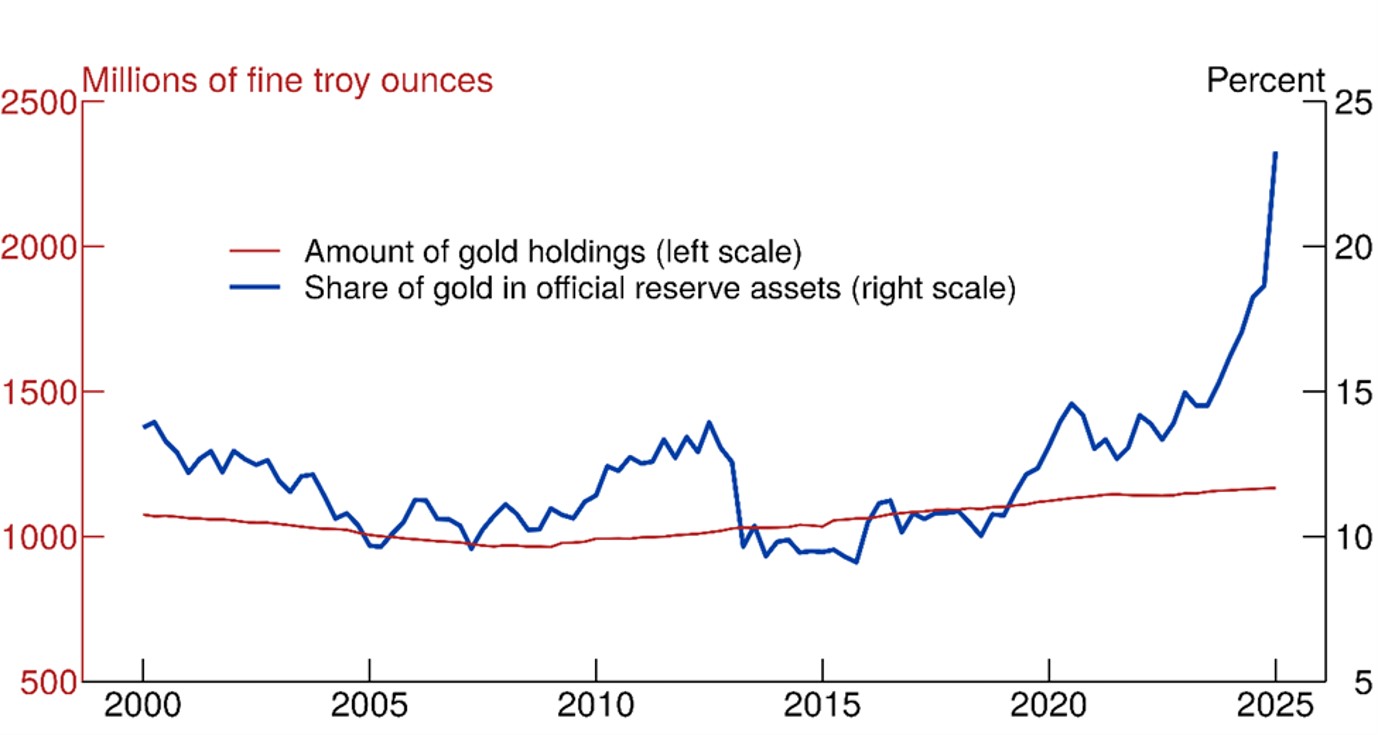
Central banks’ gold holdings
Figure: Share of gold in official reserves (market value as a percent of total reserves)
Source: IMF International Financial Statistics and FRB
Gold and currencies
Turning to gold and cryptocurrencies, Pyshkin said they sit at opposite ends of the risk spectrum.
“We consider gold to be low risk, while cryptocurrencies are extremely high risk. Nonetheless, both serve as hedges against fiat currencies at a time when confidence in paper money has weakened,” he said.
“In our 2025 outlook, we discussed the ‘weaponisation’ of the US dollar, referring to the increasing willingness of the US to restrict dollar usage by regimes it deems hostile. This has contributed to a gradual erosion of the dollar’s share in central bank reserves, a key driver behind the sharp rise in gold prices.
“Similarly, the European Union has demonstrated a willingness to consider the expropriation of Russian central bank reserves held in euros. Although recent attempts were blocked, the precedent has been established, and we expect the euro’s share of global reserves to decline over time,” he said.
Pyshkin said that for central banks, gold remains the primary alternative. Silver is less attractive due to storage constraints, leading some institutions to consider cryptocurrencies as a supplementary reserve asset.
“The long-term outlook for crypto is further supported by increasing institutional adoption, facilitated by improved access through ETFs. While we remain long-term positive on cryptocurrencies, their volatility makes them unsuitable for risk-averse investors.
“Among fiat currencies, the Swiss franc remains our top choice, reflecting Switzerland’s ability to avoid populist policy shifts. In contrast, we hold a negative view on the British pound,” he added.
Related
Investment Outlook 2026
Maintain conservative positioning with half portfolio in Gold and Swiss or CHF-hedged assets; equal allocation between bonds/equities. By Kirill Pyshkin Chief Investment Officer of WELREX We maintain a conservative investment outlook for 2026, characterised by the following positioning: But before we detail our 2026 investment outlook below, we would like to review the final performance […]
Quantum technologies: the next digital revolution
Kirill Pyshkin Investors fear the quantum concept as an unknown quantity, but once they analyse case studies around its transformative nature, it is likely to rival the potential of AI © Envato This article was published in PWM, and FT-affiliate publication, on 14 Nov. 2025 The year 2025 marks a century since quantum mechanics reshaped […]
Can Europe afford its rearmament?
WELREX Chief Investment Officer Kirill Pyshkin shares his latest thoughts
TRiUMPh of the Contrarians
WELREX CIO Kirill Pyshkin updates on our 2025 Investment Outlook 3 months on
Robots, relationships and revolutionary investments
WELREX CEO Yevgeni Agerd is interviewed by Yuri Bender and Ali Al Enazi as part of the FT/PWM “Tea Break” series. They discuss the future of wealth management and whether peace talks in Ukraine can spur a much-needed recovery for troubled European economies.
Could 2025 be a better year for thematic equities?
In this article, Kirill Pyshkin, Chief Investment Officer at WELREX, examines whether 2025 could be a better year for thematic funds.
US equities and the dollar deliver a ringing endorsement of Trump. What now?
WELREX Chief Investment Officer, Kirill Pyshkin, offers our investment outlook for 2025 with a non-consensus preference for European vs US assets, including equities, fixed income, and EUR/USD. We like Gold and CHF as a USD inflation hedge but are cautious about commodities.
“Rapid ascent for WELREX – thoughts on business models, Consumer Duty, and more”
Updated WELREX profile published by WealthBriefing following WELREX® Founder and CEO Yevgeni Agerd and Chief Marketing Officer Joe Clift interview with Tom Burroughes, Group Editor.
WELREX included in 2024 WealthTech100 listing
Sixth annual WealthTech100 list names WELREX in their list of companies transforming the world of wealth and asset management.
WELREX joins global elite with double win at WealthBriefing European Awards 2024
At the WealthBriefing European Awards on March 21st, leading wealth management industry participant, WELREX, was selected as a winner in the ‘Innovative Use of Artificial Intelligence’ and ‘Most Promising New Entrant’ categories.
Data, dashboards, and digital wealth
WELREX founder and CEO Yevgeni Agerd speaks to PWM’s editor-in-chief Yuri Bender about the increasing appetite of private investors in developing countries for a hybrid digital and human advice model
WELREX CIO, Kirill Pyshkin, invited to present at University of Cambridge
Last week, our Chief Investment Officer, Kirill Pyshkin, led a class of University of Cambridge Master of Finance students at Judge Business School, where he shared his extensive experience in developing and managing thematic investment strategies. Thematic investing, as Kirill explained, is all about identifying the powerful, long-term trends shaping our future and translating them […]
Strong 1H 2025 Performance of Our Thematic Investment Strategies
In a financial landscape constantly reshaped by powerful global forces, understanding and responding to long-term trends is paramount. At WELREX, we believe in a proactive approach to investment, rooted in deep thematic analysis and a multi-asset strategy designed to navigate complex markets. As we reflect on the first half of 2025, our Chief Investment Officer, […]
US Treasuries deserve another look
The recent escalation in the Israel-Iran conflict has sharpened investor focus on the relationship between oil prices and financial markets. While the typical ‘risk-off’ response—favouring bonds and pressuring equities—is well understood during periods of geopolitical tension, the implications of rising oil prices are more nuanced. Moreover, most economists speak in unison about their overwhelming belief that Trump’s […]